Creator Generated Content vs UGC: What’s the Difference? | Retro Crush Media
Authentic content has evolved—and so have the creators behind it.
For years, User Generated Content (UGC) has been one of the most effective forms of digital advertising because it solved a problem traditional commercials struggled to overcome: trust. As consumers grew increasingly skeptical of polished advertising, brands discovered that real people sharing genuine experiences consistently outperformed highly produced campaigns. Viewers responded because the content felt personal, relatable, and unscripted, making recommendations seem more like conversations than sales pitches.
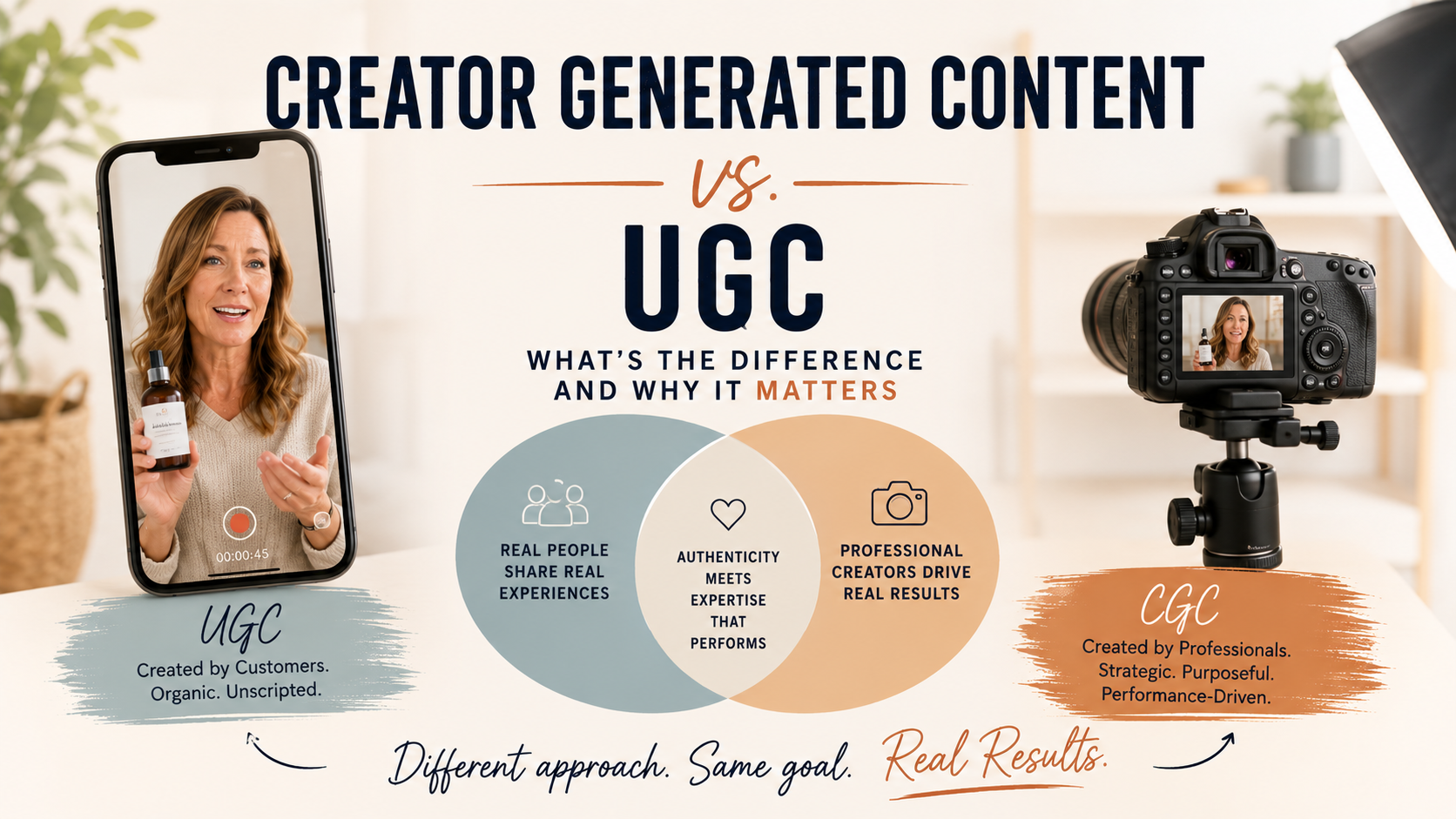
As creator marketing has evolved, however, the landscape has changed significantly. Much of what brands continue to label as “UGC” no longer fits the original definition. Instead of relying on everyday customers to casually share their experiences, companies are increasingly partnering with experienced creators who understand the principles behind high performing advertising. These creators know how to build compelling narratives, communicate naturally on camera, maintain audience attention, and balance authenticity with strategic messaging. Their content still feels genuine, but it is created with intention and a deep understanding of performance marketing.
That evolution is why the term Creator Generated Content (CGC) more accurately reflects where the industry is today. The content retains the authenticity that made UGC so successful, but it is produced by professional creators who understand storytelling, audience psychology, and commercial performance. Rather than replacing authenticity, experience enhances it, allowing brands to create advertising that feels human while consistently delivering stronger business results.
What Is Traditional UGC?
Traditional User Generated Content is exactly what the name implies. It refers to content created organically by everyday customers who genuinely enjoy a product and decide to share their experience without being hired or directed by a brand. Whether it’s someone posting a skincare routine on social media, filming an unboxing video, or recommending a favorite kitchen gadget to friends, the content is created because the individual wants to share their experience, not because they were commissioned to produce an advertisement.
That authenticity is what made traditional UGC so powerful. The content wasn’t polished, strategically planned, or developed around a creative brief. It reflected real experiences from real people, and consumers responded because it felt honest. Rather than hearing directly from a company promoting its own products, audiences were hearing from people they perceived as peers. Those genuine recommendations often carried more credibility than even the most expensive television commercial because they resembled everyday conversations instead of carefully crafted marketing campaigns.
Brands quickly recognized the influence this type of content had on purchasing decisions. As consumers placed greater trust in authentic customer experiences, marketers began looking for ways to replicate that same feeling within their own advertising. The challenge, however, was maintaining the natural authenticity of user generated content while producing creative that could be delivered consistently, aligned with campaign objectives, and scaled across multiple marketing channels. That shift marked the beginning of the creator economy as we know it today and laid the foundation for what has evolved into Creator Generated Content.
The Evolution of Creator Marketing
As demand for authentic content continued to grow, brands quickly realized that relying solely on spontaneous customer posts wasn’t a sustainable marketing strategy. While genuine user generated content was incredibly valuable, it was also unpredictable. Companies couldn’t control when it would be created, whether it would align with their messaging, or if it would be suitable for paid advertising. Modern campaigns required consistency, dependable production schedules, and creators who could deliver high quality content on time while meeting specific creative objectives.
That need gave rise to a new type of professional. Rather than waiting for customers to create content organically, brands began partnering with experienced creators who understood both the art of authentic communication and the strategy behind successful advertising. Unlike traditional influencers, these creators weren’t hired because of the size of their audience. Their value came from their ability to produce content that brands could confidently use across paid social campaigns, websites, landing pages, email marketing, Amazon listings, television, and virtually every other customer touchpoint.
Although the finished videos still feel personal, conversational, and relatable, there is a significant difference behind the scenes. Every element, from the opening hook and pacing to product demonstrations, emotional delivery, and calls to action, is created intentionally. The authenticity remains, but it is supported by experience, strategy, and a clear understanding of what drives attention, builds trust, and ultimately motivates people to take action. That evolution is what distinguishes today’s Creator Generated Content from the original concept of User Generated Content.
Why Creator Generated Content Is Different
Creator Generated Content represents the natural evolution of traditional UGC by combining authenticity with professional execution. Rather than simply recording a product review or reading from a creative brief, experienced creators understand how to communicate in a way that feels genuine while still accomplishing the strategic objectives of a marketing campaign. The goal is no longer just to create content that looks authentic, but to create content that consistently performs without sacrificing the human connection that made UGC successful in the first place.
That difference becomes apparent in the countless creative decisions experienced creators make throughout the production process. They understand how to capture attention within the first few seconds, deliver messaging without sounding scripted, and build trust through natural conversation rather than obvious persuasion. They know how to demonstrate products in ways that feel organic, structure content for paid advertising, and provide multiple hooks, takes, and variations that allow marketing teams to test different creative approaches. These are not accidental skills. They are developed through years of experience producing commercial content that balances storytelling with measurable performance.
The finished product still feels authentic because it is authentic. The creator isn’t pretending to be someone else or manufacturing an artificial personality for the camera. Instead, they are using professional communication skills to present a message in a way that feels honest, relatable, and believable. Experience doesn’t replace authenticity. It strengthens it by removing distractions, improving delivery, and helping viewers focus on the story rather than the production itself.
Experience Improves Performance
One of the biggest misconceptions surrounding Creator Generated Content is the belief that experience somehow diminishes authenticity. Some marketers assume that the more skilled a creator becomes, the more polished and less believable their content will feel. In reality, the opposite is often true. Experience allows creators to move beyond thinking about the mechanics of being on camera and focus entirely on the audience they are trying to reach.
Professional creators understand that authenticity is not about appearing unprepared or unscripted. It is about communicating in a way that feels natural, relatable, and sincere. Years of experience help them master the subtle skills that viewers rarely notice consciously but respond to instinctively. They understand pacing, eye contact, emotional storytelling, product framing, natural pauses, and the psychology behind why people continue watching. Those communication skills allow the message to take center stage rather than drawing attention to the person delivering it.
The highest performing Creator Generated Content doesn’t succeed because it looks less professional. It succeeds because the professionalism becomes almost invisible. Instead of noticing the lighting, the camera, or the delivery, viewers become immersed in the story itself. They stop evaluating whether they are watching an advertisement and begin focusing on how the message relates to their own experiences. That is where trust is built, and trust is ultimately what drives meaningful engagement and purchasing decisions.
Why Brands Are Choosing CGC
Today’s marketing teams are already staffed with talented creative directors, copywriters, strategists, and media buyers who have carefully developed the campaign objectives long before filming begins. What they often need is not someone to reinvent the strategy, but someone who can bring that strategy to life in a way that feels natural, engaging, and believable on camera.
Experienced creators contribute far more than a finished video. They understand the intent behind the creative brief and recognize how subtle adjustments can dramatically improve performance without changing the message itself. If a line sounds unnatural, they know how to rephrase it while preserving the brand’s voice. If the opening hook lacks urgency, they understand how to strengthen it. If a product demonstration feels forced or overly complicated, they know how to simplify it so the audience remains engaged rather than distracted.
These refinements may seem minor in isolation, but together they often determine whether content feels like an obvious advertisement or a genuine recommendation. Experienced creators understand that successful commercial content isn’t created by simply following instructions word for word. It comes from understanding why those instructions exist and using professional communication skills to deliver the message in a way that builds trust, holds attention, and supports the overall goals of the campaign.
Creator Generated Content Works Across Every Platform
One of the greatest advantages of working with an experienced Creator Generated Content professional is versatility. Modern marketing campaigns rarely rely on a single type of asset. A product launch may require short form social ads, a long form Video Sales Letter, product demonstrations for Amazon, website hero videos, landing page content, email marketing assets, and fresh creative for paid advertising. While these deliverables serve different purposes, they all need to communicate a consistent brand message and maintain the same level of authenticity.
Experienced creators are uniquely positioned to support this entire ecosystem because they understand how to adapt their performance to different platforms without losing the qualities that make the content effective. The same creator who produces a conversational social media advertisement can also deliver a persuasive Video Sales Letter, a product demonstration, educational content for a landing page, or creative designed specifically for whitelisting campaigns. Rather than changing the message, they adjust the style, pacing, and delivery to match the audience and the platform where the content will be viewed.
For brands, this creates far more than production efficiency. It creates consistency. Working with a single creative partner across multiple campaign types helps establish a recognizable voice, strengthens brand identity, and simplifies the production process. Instead of onboarding multiple specialists for every marketing channel, brands gain an experienced partner capable of creating high performing content throughout the customer journey, from the first advertisement someone sees to the final video that helps them make a confident purchasing decision.
The Best Creator Relationships Continue Growing
One of the greatest advantages of Creator Generated Content is that its value extends well beyond a single campaign. Unlike traditional advertising, where each project often begins with a new agency, production team, or spokesperson, creator partnerships become increasingly effective as the relationship develops. With every campaign, the creator gains a deeper understanding of the brand’s products, target audience, messaging, and long term objectives. That familiarity allows each new project to begin from a stronger foundation than the last.
As the relationship matures, the entire creative process becomes more efficient. Communication becomes clearer because both sides understand each other’s expectations. Creative briefs become more focused, revisions become less frequent, and production moves more quickly because the creator already understands the brand’s voice and the type of messaging that resonates with its customers. Instead of spending valuable time explaining the fundamentals of every campaign, marketing teams can focus on refining strategy and testing new creative approaches.
Perhaps most importantly, long term creator partnerships produce greater consistency across every customer touchpoint. The creator evolves from simply producing videos to becoming a trusted extension of the marketing team, capable of representing the brand with confidence, authenticity, and a genuine understanding of its goals. That is why many of today’s most successful companies invest in ongoing creator relationships rather than continually searching for someone new. The greatest return often comes not from finding a different creator for every campaign, but from building a partnership that becomes stronger with every project.
Authenticity Still Wins
One of the biggest misconceptions in modern marketing is the belief that authentic content should look unpolished. Some marketers assume that shaky camera work, inconsistent lighting, awkward delivery, or minimal production somehow makes an advertisement feel more genuine. While that may have been true during the earliest days of social media, today’s consumers are far more sophisticated. They recognize the difference between content that is intentionally conversational and content that simply lacks professional execution.
Authenticity has never been about production quality. It has always been about honest communication. Viewers respond to creators who speak naturally, communicate sincerely, and make them feel understood. Professional lighting, clean audio, and thoughtful framing do not diminish that authenticity. They simply remove distractions that compete with the message, allowing the audience to focus on the story rather than the technical shortcomings of the production.
Ultimately, consumers rarely remember what camera was used to film an advertisement or whether the lighting was perfectly balanced. What they remember is how the content made them feel. They remember whether the message felt believable, whether the creator earned their trust, and whether the story resonated with their own experiences. The strongest commercial advertising succeeds not because it appears amateur, but because it combines authentic human communication with professional execution in a way that feels effortless.
The Future of Creator Marketing
Creator marketing has evolved far beyond its roots in traditional User Generated Content. While authenticity remains just as important as it was when the first customer reviews and unboxing videos began influencing purchasing decisions, the expectations placed on creators have changed dramatically. Today’s brands are no longer looking solely for content that feels relatable. They also need dependable creative partners who can deliver consistent results, understand campaign objectives, and produce assets that perform across multiple platforms and marketing channels.
That is where Creator Generated Content has emerged as the natural evolution of the industry. It preserves the authenticity that made User Generated Content so effective while adding the experience, strategic thinking, and professional execution required by modern marketing teams. Rather than choosing between content that feels genuine and content that is built to perform, brands can have both. Experienced creators understand how to communicate naturally while also applying the principles of storytelling, audience psychology, and performance marketing that help campaigns achieve measurable results.
As the creator economy continues to mature, the distinction between User Generated Content and Creator Generated Content will become increasingly important. The brands that see the greatest return on their investment will not be those chasing the newest trend or searching for the largest following. They will be the ones who invest in experienced creators capable of building trust, representing their brand consistently, and creating content that continues to perform long after it is published.
The future of creator marketing is not about replacing authenticity with professionalism. It is about bringing the two together in a way that feels effortless. When genuine human communication is supported by experience, strategy, and thoughtful execution, advertising stops feeling like advertising. It becomes something far more powerful: a story people choose to watch, believe, and remember.